AI phone agents are no longer experimental tools. In 2026, they operate as revenue-driving infrastructure across sales, support, healthcare, and financial services.
That shift makes pricing strategy critical.
This Retell AI pricing breakdown vs superU comparison goes beyond per-minute rates. It examines how each platform structures costs, how those costs scale, and what organizations should consider when evaluating total cost of ownership.
Because in AI calling, small cost differences compound quickly.
The Reality of Voice AI Pricing
Voice AI platforms typically charge based on usage. But usage itself has layers:
- Call minutes
- LLM token consumption
- Voice synthesis processing
- Telephony carrier fees
- Concurrent call handling
- Escalation transfers
- Webhook-triggered workflows
On paper, two platforms may appear similar.
In production, their pricing behavior can diverge significantly.
Understanding how pricing scales is more important than understanding how it starts.
Retell AI Pricing Model Overview
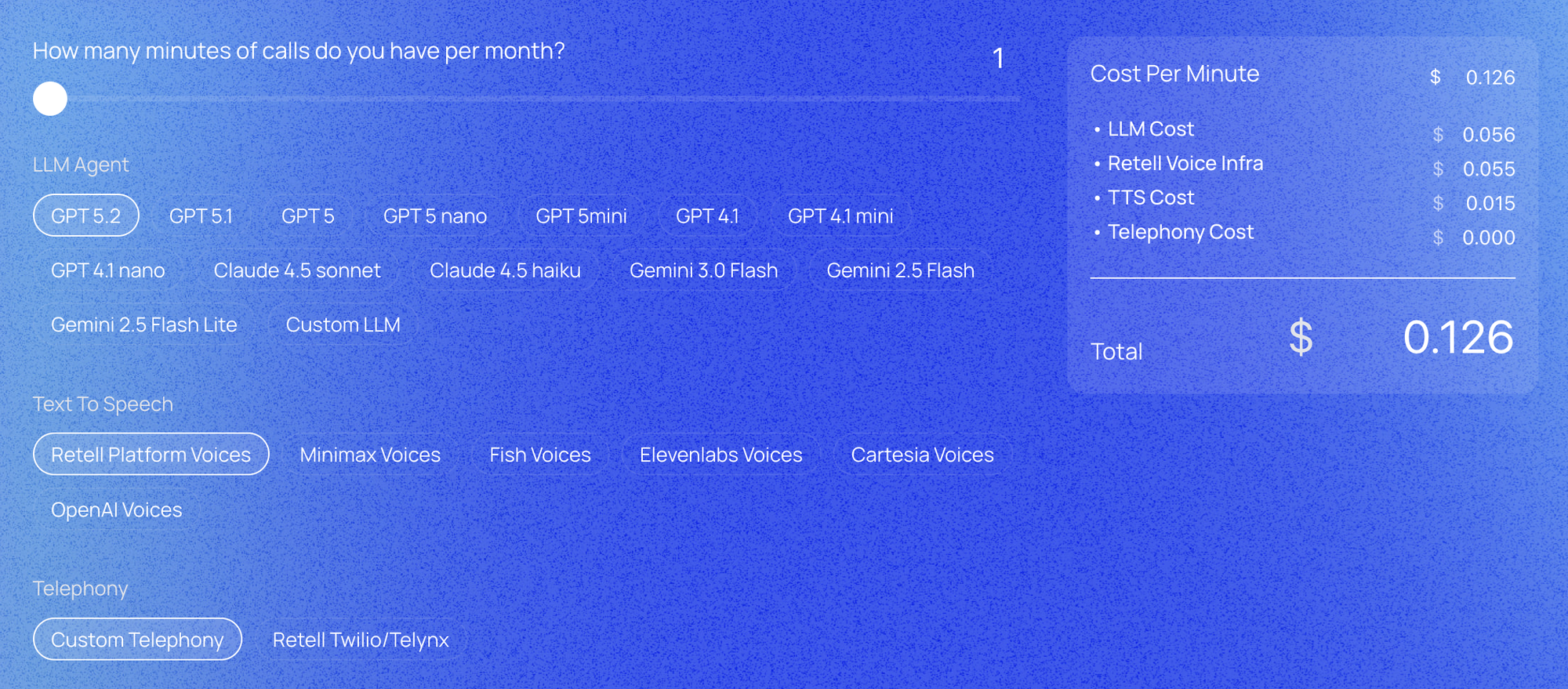
Retell AI follows a usage-based pricing structure centered around API-driven voice agent deployment.
Typical cost components may include:
- Per-minute AI call processing
- LLM token usage
- Voice generation costs
- Separate telephony provider integration
- Infrastructure scaling tied to volume
This model offers flexibility. Teams can experiment with minimal upfront commitment and scale gradually.
However, as usage increases, variability increases as well.
Outbound campaigns using AI phone agents can rapidly increase token consumption and per-minute billing. Additionally, if telephony infrastructure is not bundled, organizations may need to manage separate carrier contracts.
For developer-led teams comfortable with assembling orchestration layers, this flexibility can be attractive.
For organizations seeking predictable scaling economics, variability can introduce forecasting challenges.
superU’s Pricing Approach
superU takes a more infrastructure-centric pricing approach.
Rather than separating voice generation, telephony infrastructure, and workflow orchestration into independent cost layers, superU integrates them within a unified platform.
This influences pricing in three major ways:
- Consolidated telephony infrastructure
- Embedded scalable voice AI architecture
- Native voice AI human escalation workflows
By reducing reliance on external services, superU simplifies billing structures and often improves predictability at scale.
The emphasis is less on raw per-minute cost and more on long-term operational efficiency.

Stage-by-Stage Cost Comparison
Early-Stage Deployment (Low Volume)
At low call volume, Retell AI’s usage-based model may appear highly cost-effective. Teams only pay for minutes and tokens consumed.
superU may offer competitive pricing, but its architecture is optimized for structured production deployment rather than experimental iteration.
At this stage, the financial difference is often minimal.
The decision typically depends on engineering preference.
Growth Phase (Mid-Scale Campaigns)
As call volume increases — particularly for outbound AI phone agents — cost behavior begins to shift.
Usage-based billing grows linearly with minutes and token usage.
In this phase, organizations must consider:
- Increasing concurrency
- Escalation handling costs
- CRM and webhook automation frequency
- Latency optimization requirements
If orchestration and telephony infrastructure are managed externally, operational overhead also rises.
superU’s bundled telephony infrastructure and scalable voice AI architecture reduce the need for additional systems, which can stabilize total monthly cost as volume grows.
At mid-scale, predictability begins to matter more than entry pricing.
Enterprise Scale (High Concurrency)
At high call volumes, cost efficiency depends on architecture.
Unstable latency increases call duration. Longer calls increase AI phone agent cost.
Fragmented infrastructure increases failure rates. Failures create repeat calls and manual intervention, indirectly increasing expenses.
Retell AI’s flexible API model may require additional engineering investment to maintain reliability at this level.
superU’s infrastructure-first model is designed to handle:
- High concurrency
- Structured monitoring
- Integrated telephony optimization
- Real-time workflow execution
At enterprise scale, total cost of ownership voice AI becomes the dominant metric.
Reliability reduces hidden expenses.
Hidden Costs Often Overlooked
When evaluating Retell AI pricing breakdown vs superU, organizations should account for indirect factors:
Engineering Maintenance
Developer-managed orchestration consumes time. Internal teams must maintain webhook logic, scaling policies, and monitoring dashboards.
Infrastructure labor contributes to real cost.
Telephony Complexity
Separate carrier contracts introduce additional billing, management, and optimization layers.
Bundled telephony infrastructure simplifies forecasting.
Latency and Call Duration
Voice AI latency impacts call efficiency.
Platforms with optimized streaming pipelines can shorten average call length, reducing cost per interaction.
Even a 10% reduction in call duration can significantly affect monthly billing at scale.
Escalation Efficiency
Structured voice AI human escalation prevents unnecessary transfers and duplicate conversations.
Without it, both AI minutes and human labor costs increase.
The Core Difference
The Retell AI pricing breakdown vs superU comparison ultimately reflects two philosophies:
Retell AI → Usage-based, API-driven flexibility
superU → Infrastructure-driven, production-scale stability
Retell AI empowers developers to build customized systems.
superU reduces complexity by embedding scalable voice AI architecture and telephony infrastructure directly into the platform.
The right choice depends on organizational priorities:
- Do you prioritize flexibility or operational simplicity?
- Do you expect moderate usage or rapid scaling?
- Do you have internal engineering bandwidth for orchestration?
Final Perspective
Pricing is rarely just about rates.
It is about predictability, scalability, and operational resilience.
When comparing Retell AI pricing breakdown vs superU, focus on:
- Long-term AI phone agent cost behavior
- Telephony infrastructure inclusion
- Voice AI pricing model scalability
- Escalation efficiency
- Engineering overhead
AI calling is compounding infrastructure.
A slightly cheaper per-minute rate today may become more expensive tomorrow if the architecture cannot scale efficiently.
The most cost-effective platform is the one that maintains stability while volume grows.